Multi-Property T&M Bill Validation
How confident are you that all related T&M bills can be true at the same time?
A T&M invoice can appear supportable on its own and still contain cross-property conflicts that are difficult to see in an individual review. Duplicate labor, overlapping time, repeated equipment, shared costs, allocation inconsistencies, and support gaps can emerge only when the related bills are tested together.
Difference identified by merging 38 property bill files before the additional review layers shown in the illustration.
Combined illustration after merge findings, common billing rules, equipment terms, taxes, and fees were evaluated.
Difference identified in the five-property case after the related invoices and contractor-provided support were reviewed together.

The Validation Gap
One event. Many invoices. The blind spot can be the relationships between them.
A school system, municipality, commercial owner, or other organization may have one Master Service Agreement, pre-loss agreement, or emergency mitigation agreement with one restoration contractor. A single catastrophe can then create separate T&M invoices for every damaged property. Each invoice may pass an individual review, yet the review may never test the relationships that exist across the full event.
Validates the invoice in front of you.
Tests whether the related invoices remain consistent together.
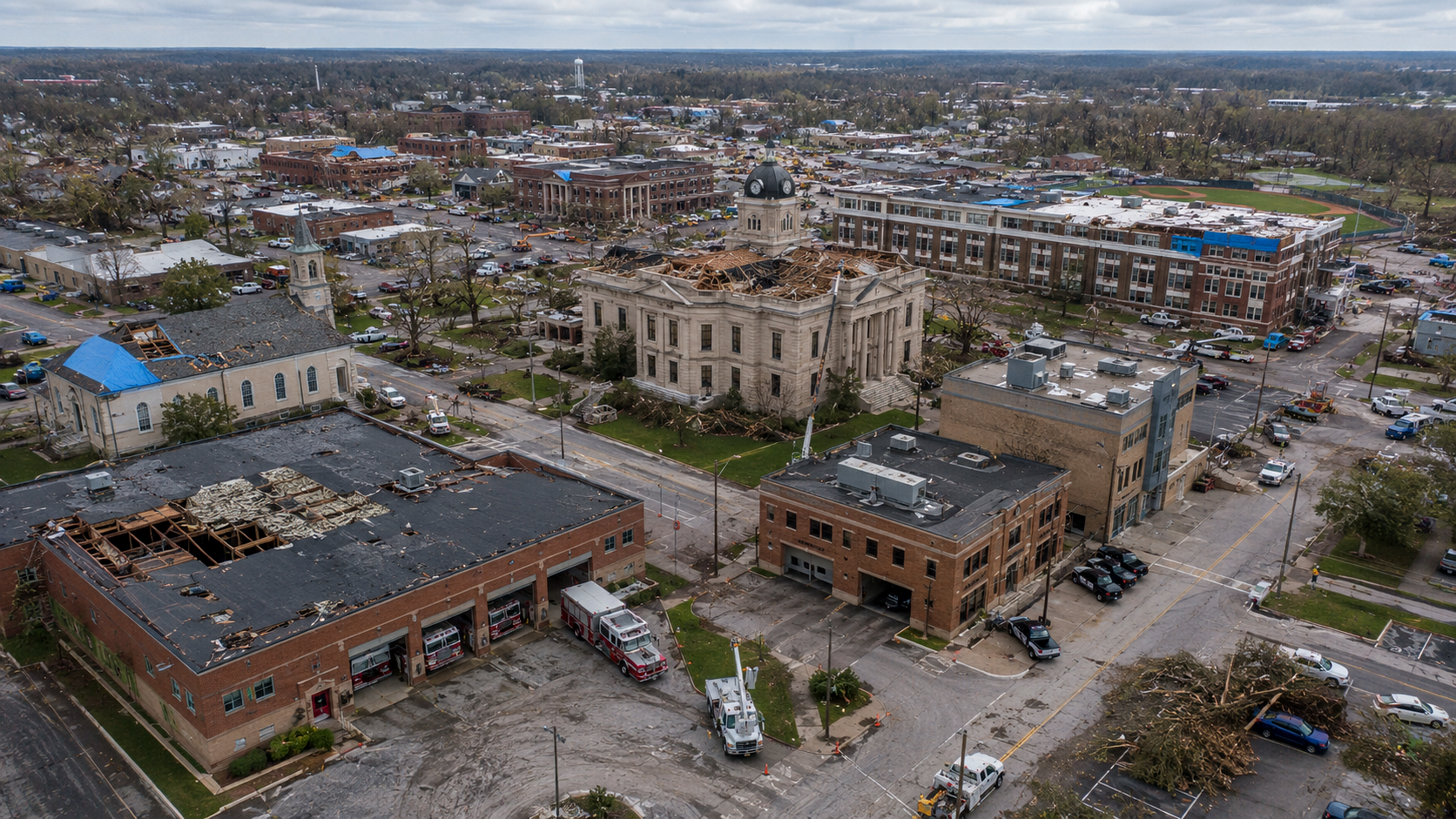
The event is shared even when the invoices are not.
School districts and municipalities often manage a campus, downtown district, or portfolio of facilities that can all be affected by the same storm. That is why the merge process is designed to follow the event, not just the individual property file.
When the same crews, supervision, equipment, vehicles, vendors, lodging, and mobilization costs can move across several locations, the relationships between invoices become part of the validation.

Third-Party Reimbursement
Before payment or reimbursement, validate the event, not just the next invoice.
When T&M invoices may be submitted to an insurer, FEMA Public Assistance, or another third-party funding source, the organization is not only deciding whether to pay a contractor. It may also be relying on the same billing record to support reimbursement. A merged review can strengthen that validation by identifying cross-property conflicts before submission, before claim closure, or during a post-submission review.
One event can create two different review questions.
The first question is whether a contractor invoice should be paid under the governing agreement. The second is whether the cost record being relied upon for reimbursement is complete, consistent, supported, and aligned with the requirements that apply to that reimbursement request. A merge review does not determine coverage or FEMA eligibility, but it can reveal billing conflicts that should be resolved before those invoices are relied upon.
Before final payment
Validate the relationship among invoices while questions can still be addressed with the contractor and project records are readily available.
Before reimbursement submission
Reduce the risk of submitting a portfolio of invoices that appear valid individually but contain conflicts when evaluated together.
Post-submission or past event
A merged review can still be used to validate related T&M invoices after payment or submission when the supporting records remain available.
Step One | Merge the Bills
The first result appeared when the 38 property bill files were connected.
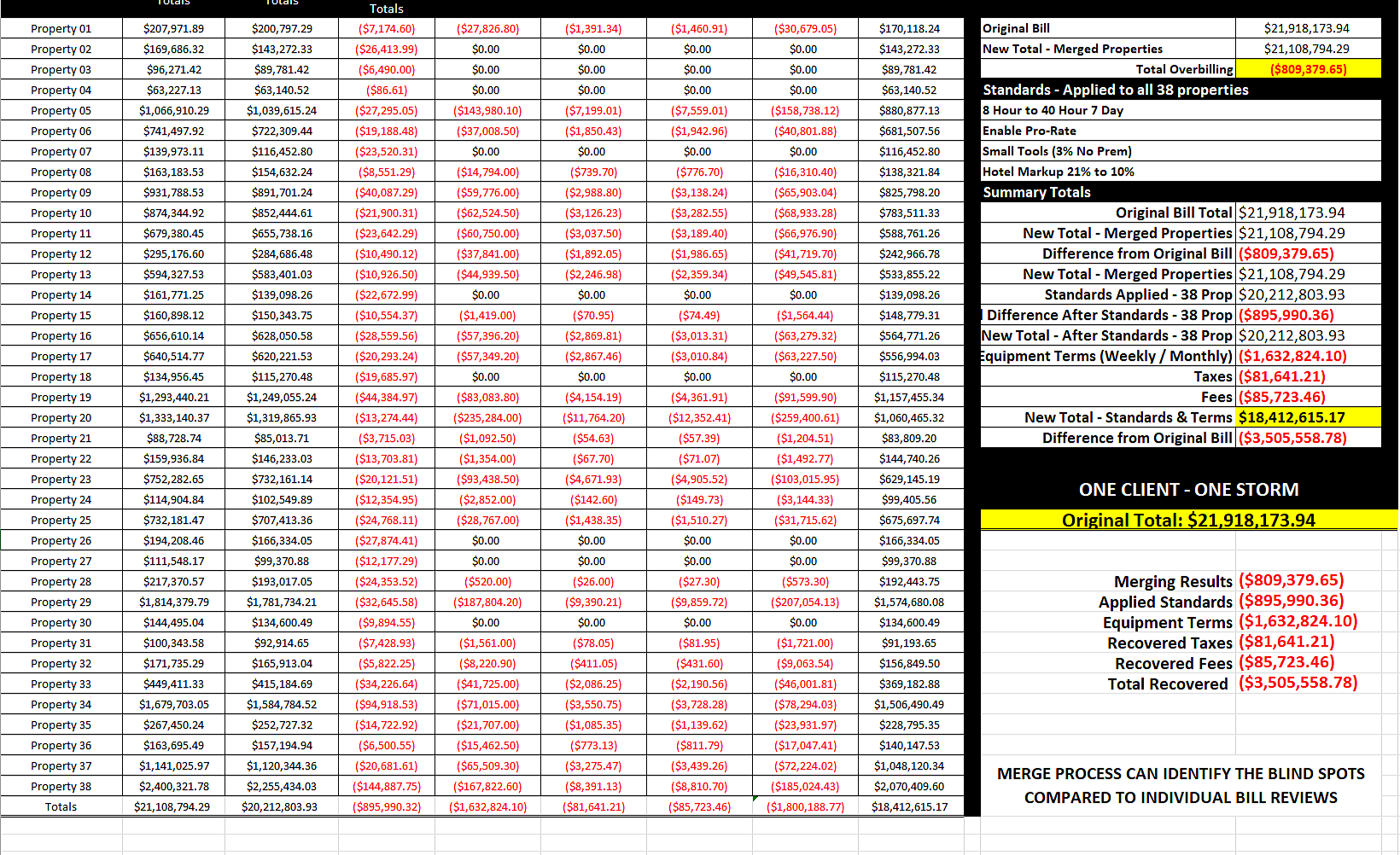
In the illustration, the 38 properties were billed separately by the same contractor under one governing agreement. The first analytical step was the merge itself. No prices were changed in this merge-only step. The illustration shows a $809,379.65 difference after the property bill files were connected and evaluated together, before the additional billing-rule and commercial-term review layers shown below.
Step Two | Apply the Rest of the Review
The merge reveals the relationships. Then the full event-level review begins.
Once the event is consolidated, the reviewer can apply the same billing criteria, equipment terms, tax treatment, fee treatment, and agreement requirements across the full portfolio. The illustration below shows how each layer changes the event total.
Cross-property relationships identified when the 38 bill files are evaluated together.
($809,379.65)Illustrated application of consistent rules across all related property invoices.
($895,990.36)Illustrated review of weekly and monthly equipment billing terms.
($1,632,824.10)Illustrated tax and fee adjustments shown in the consolidated analysis.
($167,364.67)Combined difference shown after the merge and all additional illustrated review layers.
($3,505,558.78)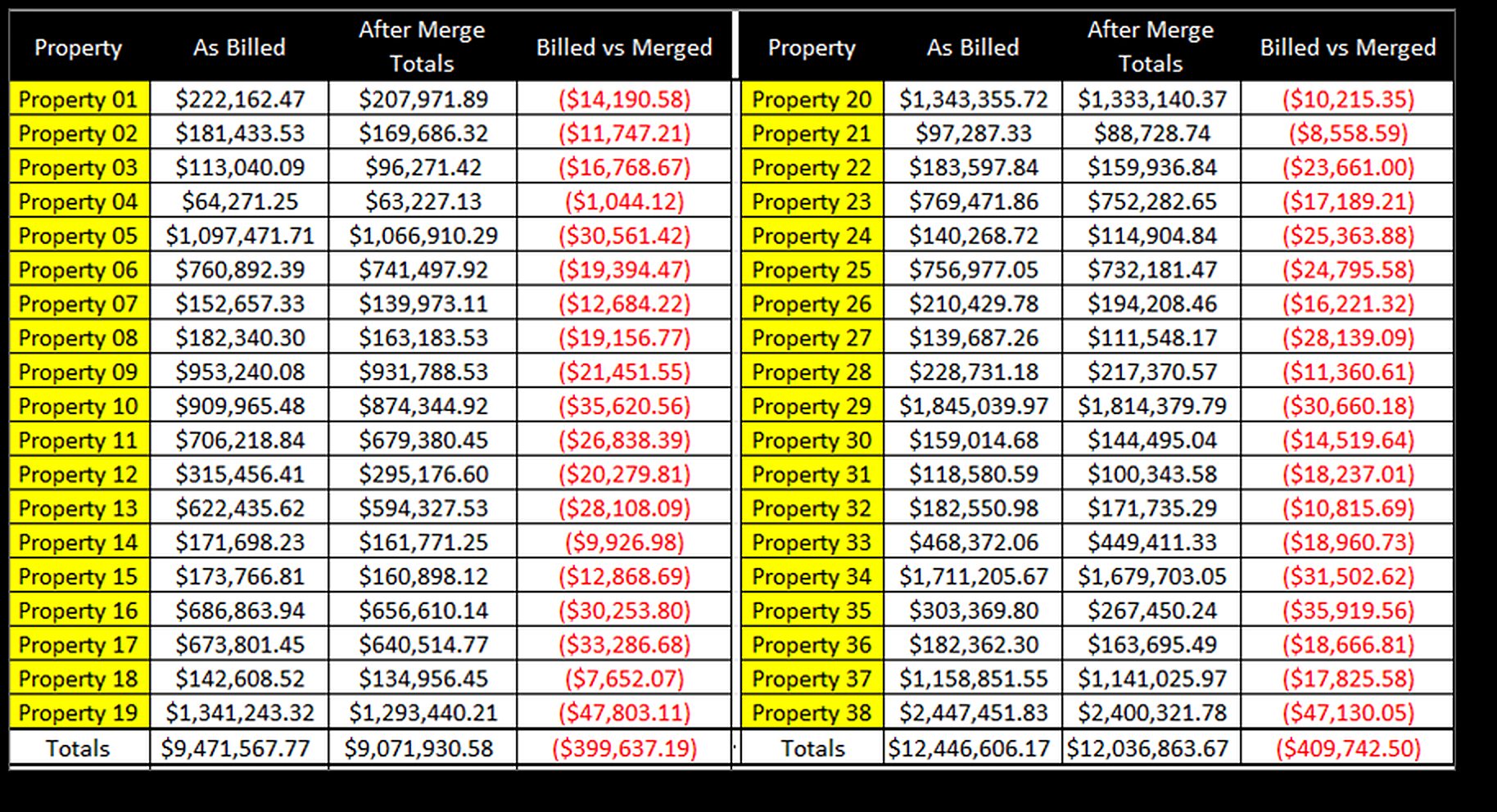
What Changed
Five invoices that could be reviewed separately told a very different story after they were merged.
The merged review produced a $447,278.39 difference between the combined billed amount and the revised total shown in the case study. More important than the percentage is what the merged data revealed across the five property files.
Duplicate labor across properties
One example showed the same project manager billed for 9 hours at four locations on the same day, creating 36 cumulative billed hours in a 24-hour period. Additional merged records reflected cumulative daily hours exceeding 50 hours. Those relationships are difficult to evaluate when each property file is reviewed alone.
Overlapping time between locations
The merged data showed labor periods that conflicted between different locations, creating cross-property questions that were not visible within one invoice.
Equipment and allocation questions
Equipment quantities, usage periods, and supporting records were evaluated across all five locations instead of being accepted as five unrelated equipment stories.
Supporting-document gaps
The review identified missing or incomplete support in areas that included labor documentation and a subcontract charge for which the supporting invoice was not included.
| Property | Original Billed Amount | Revised Total | Difference |
|---|---|---|---|
| Property 1 | $164,801.40 | $84,945.56 | $79,855.84 |
| Property 2 | $194,529.88 | $105,248.39 | $89,281.49 |
| Property 3 | $161,721.94 | $82,320.58 | $79,401.36 |
| Property 4 | $225,564.65 | $106,277.82 | $119,286.83 |
| Property 5 | $205,142.45 | $125,689.58 | $79,452.87 |
What the Merge Can Test
The blind spots often live between the invoices.
A merged review creates one event-level data set, allowing related invoices to be compared against each other and against the governing agreement and supporting records.
Labor and supervision
Duplicate people, overlapping time, cumulative hours, repeated supervision, and crew allocation across properties.
Equipment and vehicles
Conflicting location assignments, duplicate units, inconsistent usage periods, and weekly or monthly term application.
Lodging, per diem, and travel
Shared deployment costs that may be duplicated, overstated, or allocated inconsistently among related properties.
Mobilization and shared costs
Management, logistics, temporary labor, specialty vendors, and other event-level resources charged across multiple properties.
Agreement consistency
Rates, markups, minimums, fees, taxes, billing periods, and other commercial rules applied consistently across every invoice governed by the same MSA.
Supporting-document alignment
Field records, timesheets, equipment logs, vendor invoices, and billing data evaluated as one connected event record.
The Review Process
Five steps turn separate property bills into one event-level analysis.
The objective is not simply to identify a questionable line item. It is to determine whether the body of related billing is internally consistent, supported, and aligned with the governing agreement before those invoices are relied upon for payment or reimbursement.
Collect
Gather invoices and supporting records for all properties tied to the same event, contractor relationship, and governing agreement.
Normalize
Structure names, dates, labor, equipment, vehicles, vendors, costs, and billing rules so they can be compared consistently.
Merge
Combine the related property bill files into one event-level data set that can expose cross-property relationships.
Test
Evaluate overlaps, duplication, cumulative hours, equipment usage, shared costs, support, and consistent application of the governing agreement.
Report
Document findings for informed decision-making before final payment, before reimbursement submission, or as a post-submission validation review.
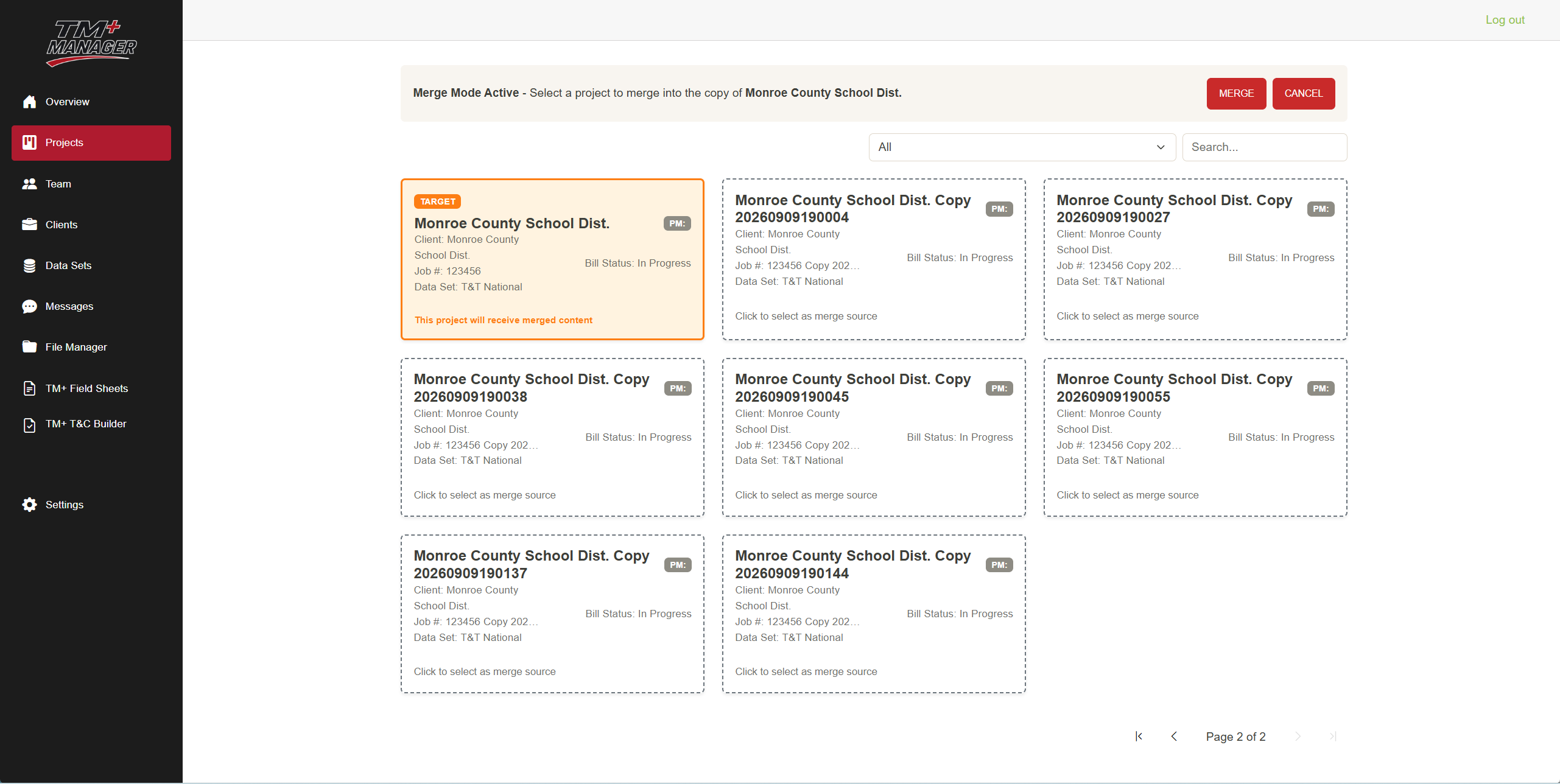
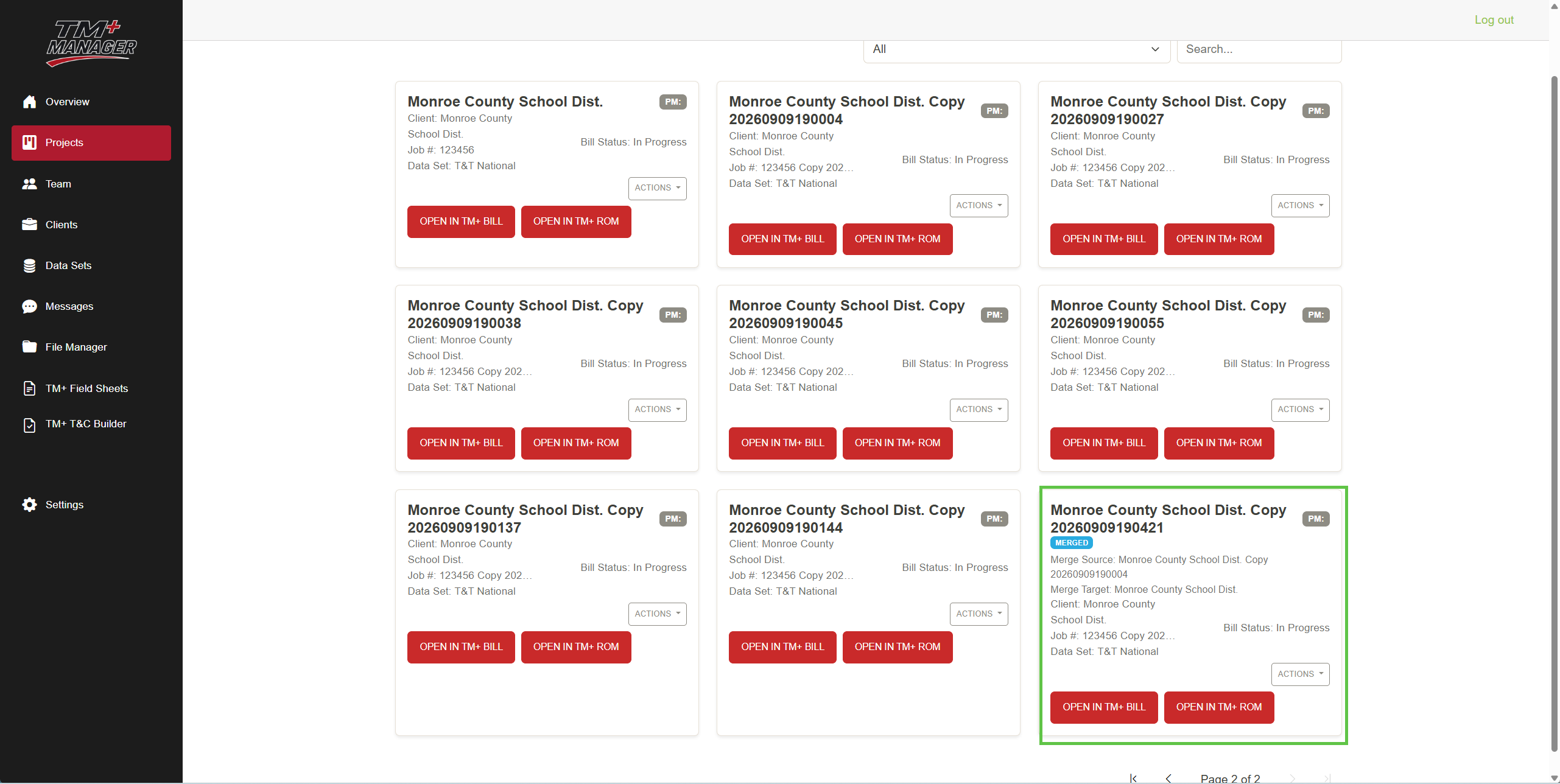
TM+ brings the related bill files together while keeping the original files intact.
We use the TM+ Platform to perform the merge of multiple bill files. One file is designated as the Target, and the remaining related bill files are selected as the Sources. Once the merge process begins, the original files remain intact while TM+ creates a new merged file containing the combined data from the selected source bill files. This gives us a complete event-level view of the data across all locations in one platform.
With the complete data set assembled, we run the analysis across the merged record, including the governing agreement's terms and conditions, pricing, labor, equipment, shared costs, supporting documentation, and other applicable billing criteria to evaluate whether the related bills are fully aligned.
One More Validation Step
If the event is connected, the review should be connected too.
Merge the related invoices before final payment, reimbursement submission, or claim closure. The individual property bills may tell part of the story. The merged event record can tell you whether those stories remain consistent together.